
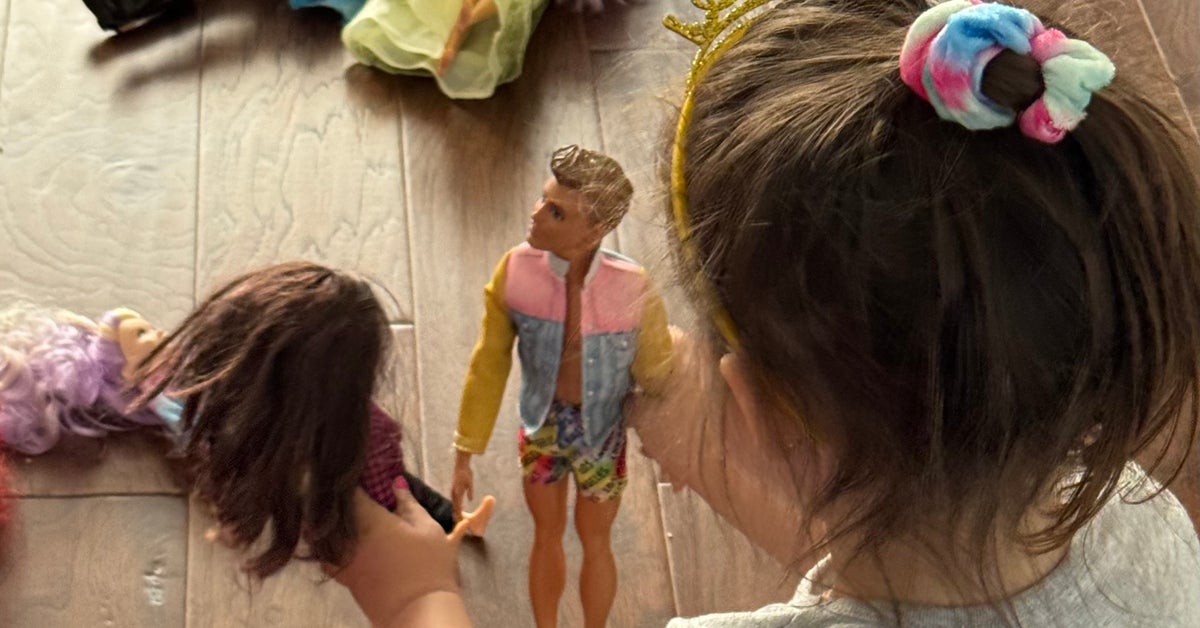
In the past few weeks, I’ve attended dozens of weddings. Luckily, I didn’t need new clothing for each one. But I have been tasked with outfitting numerous guests, and even the bride and groom themselves, squeezing skimpily made garments with Velcro closures onto slender bodies.
We’re talking plastic bodies ― Barbies, Kens, Skippers, Chelseas and Disney princesses. Dozens of them pepper the playroom of my 4-year-old granddaughter. “They’re getting married,” is the phrase that she voices every time — and it’s plenty of times — that she recruits me to “play Barbie.”
Barbie typically marries Ken, although I’ve also attended the weddings of Cinderella and Ken and Snow White and Ken. (Barbie must be flush with jealousy!) The marriage of Barbie and Barbie or Ken and Ken hasn’t yet crossed her mind, and, honestly, I feel that it’s her parents’ place, not mine, to have that conversation.
However, underscoring that kids’ imaginations — or views of reality — vary, my 3-year-old granddaughter recently exclaimed during a bath: “My mermaid is going to a wedding.” I couldn’t help but ask, “Who is she marrying?” “The other mermaid,” she exclaimed, as she began washing them to prepare for the big event.
My oldest grandchild, who is 8, has told me about people of the same sex getting married. When he’s brought it up, I’ve reinforced that scenario by simply saying, “You marry the person you fall in love with.” And I’ve added that not everyone gets married.
Photo Courtesy Of Carol Steinberg
Three of my four grandchildren have already gotten “married” — only my youngest grandchild is not hitched. My third grader married a girl when they were in preschool. My Barbie aficionado married that girl’s younger brother. And my other grandson, 5, recently married a girl in his kindergarten class.
“What does that mean?” I asked him. “We kissed,” he responded.
Why are these kids, like many others, obsessed with marriage at such a young age? Why is it the norm for them to imitate?
I’ve been thinking about this for a while, but a recent incident brought these thoughts to the forefront.
I was at the Target customer service counter, trying to return a youth-sized shirt I’d bought months earlier. The teenage customer service representative informed me that I couldn’t return it because I had already reached my limit of receipt-less returns. But, he said, as if declaring good news, “Your husband can come in and return it on his driver’s license.”
My husband? It seemed awfully presumptuous to say. I couldn’t hold back, replying something about it being inappropriate to assume that everyone is married.
Here’s where I admit that I’ve been divorced for almost 18 years. So, yes, his assumption that I have a husband hit a nerve. It’s not the Target employee’s fault that I have baggage, but is it perhaps society’s fault that the suggestion so seamlessly flew out of his mouth?
According to the Current Population Survey, in 2022, an estimated 49.2% of Americans were unmarried (never married, divorced, widowed) — in other words, single! And there’s nothing wrong with that. Research indicates that single people are, in general, satisfied with both singlehood and life.
Given this, it astounds me that this unworldly teen assumed I was married. It also amazes me that I was told that tickets were only sold in pairs when I tried to get three tickets to an upscale magic show in New York, that the price of a single room on a Caribbean cruise was more costly than my daughter’s suite for her family of four, and that almost every couple who my ex-husband and I used to socialize with on Saturday nights stopped asking me to join them on dinner dates post-divorce.
I haven’t been able to find studies on when “divorce” should become part of a child’s vocabulary, when it’s not their own parents who are divorcing. Recently, my youngest grandson asked me why “Grampa” and I are no longer married. He didn’t use the word “divorce,” but he knows I live alone, and his grandfather has another partner in the picture.
I wasn’t prepared for this question. I had to think on my feet.
“We grew apart,” I said. “We still care about each other, and we share your Mommy and aunt, and we share you, your sister and your cousins.” (I vaguely recall my ex-husband and I saying something like that to our then college-age daughters when we announced that we were divorcing.)
Did I say the right thing? How would my ex have replied? What would my daughter and son-in-law have said?
My response seemed to satisfy this inquisitive kindergartner, but then he asked again two weeks later. I gave a similar response. Since then, I’ve decided that if he asks again, I’ll likely defer the question to his parents. As a grandmother, it’s hard to discern what’s your news to share, as the saying goes.
I’m not insisting we take the little ones out of their “Barbie World” for now, but as they get older (like a certain teen at the Target counter), it might be good for them to learn that marriage is not always golden and that being single is a viable option in a world that’s still built for two.
I’m fine with being single, but even I sometimes feel uncomfortable, anxious and vulnerable when I walk into a couple-filled room. When my grandchildren become adults, I want them to feel fully “accepted,” even if they get divorced or never choose to marry at all.
Carol Steinberg is a semi-retired freelance writer and editor, and the author of a new children’s book about Alzheimer’s disease, ″Come Grandpa Meow, Let’s Fly.” Previously, she was a longtime journalist and non-profit executive at local and national Alzheimer’s organizations.
Do you have a compelling personal story you’d like to see published on HuffPost? Find out what we’re looking for here and send us a pitch at [email protected].

